Forum: The International, Responses to Gaza, and the Question of the Palestinians
Executive Summary
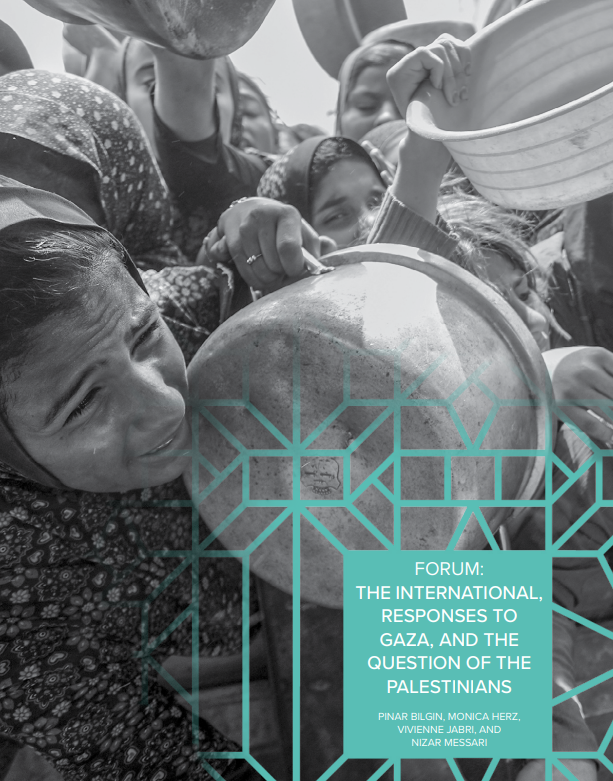
In this paper, four authors examine the impact of the war on Gaza on the international in four distinct ways: exemplifying hierarchy in anarchical society, contrasting the reactions of Arab states and Arab peoples, situating Israel within the global far-right, and solidifying the postcolonial international. Pınar Bilgin examines hierarchy in anarchical society. She argues that within the framework of an international that lacks a central authority, states still become socialized to value certain lives over others. The lack of solidarity from Arab states towards Palestinian exemplifies this. Nizar Messari outlines the reaction of the Arab world to violence against Palestinians. The Arab populations have consistently expressed solidarity, understanding Palestinians as part of an Arab “we.” Arab leaders, however, have had a much fainter sense of solidarity, preferring to emphasize national identities Monica Herz discusses Israel in the context of the global far right. Right wing parties across the world see themselves as fighting the same Muslim enemy as Israel. It is also often held up as an exemplary society, favouring a homogeneous society, religious identity, and a disregard for international law. Vivienne Jabri describes Palestine through a postcolonial lens. Palestine has often been neglected by anti-colonial analysis. However, the recent war on Gaza has sparked renewed interest, helping to construct a more solid postcolonial international.
Dedication Note
This forum is dedicated to Prof. Dr. Fuat Keyman in acknowledgement of his scholarly advocacy of countless worthy causes—as a true public intellectual. Fuat Hoca was a believer in “speaking truth to power” in the Saidian sense of the term.1 His engagements with the policy world (which were crystallized in Istanbul Policy Center) and his scholarship (including even the most abstract theoretical elaborations)2 were always crafted with an eye on what is happening in the world. “Speaking truth to power” is sometimes dismissed by skeptics who insist that those in decision-making positions (“power”) are not lacking in terms of the most correct information about events or policy advice (“truth”) but that they merely do not want to do the right thing. In the case outlined in this collection, Israel’s war on Gaza, this entails failing to follow the precepts of international law and holding violators accountable. Therefore, the skeptics insist that “power” has access to the “truth”; it just does not want to pursue it.
Publication Date
August 2025
Number of Pages
21