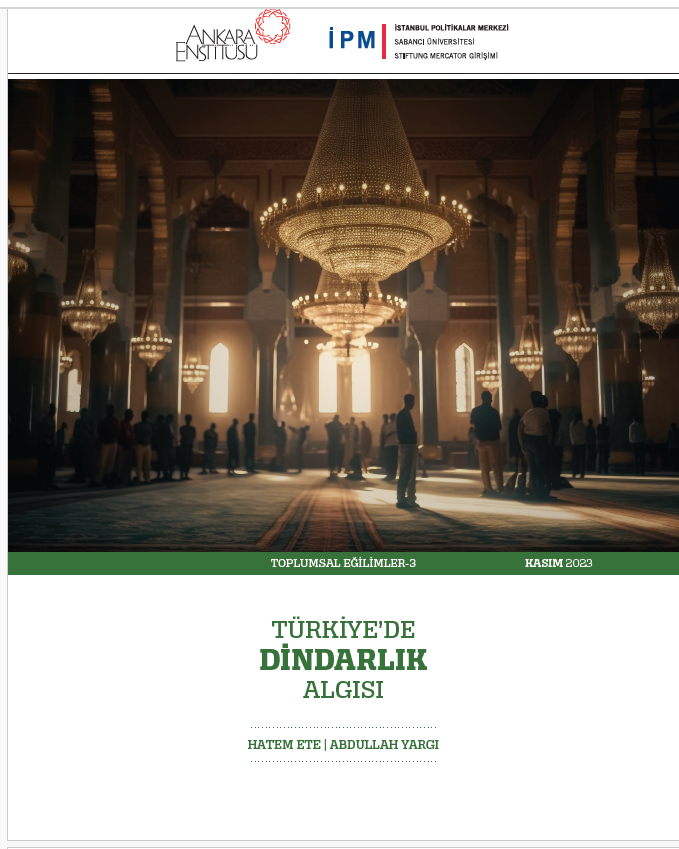
Perception of Religiosity in Turkey
Executive Summary
Our study titled "Perception of Religiosity in Turkey" presents a comprehensive analysis covering many topics related to religion, including belief distribution, asking for help from God, attitudes towards religious practices, religion-politics relationship, social change and religion, religious education, religious institutions, trust in religious leaders, and religious tolerance. Our research confirms that religion remains the most important element of identity formation in Turkey, yet it also shows that traditional forms of religiosity are being replaced by more individual forms of spirituality.
Belief Universe/Declaration
Religious Belief: 92.3% of participants stated that they are Muslim. Those who identified as deist constitute 3.2%, while those who identified as atheist constitute 2.7%. Although Muslim identity remains extremely dominant, the increase in the atheist and deist population, even if relative, is quite remarkable. Asking for Help from God through Prayer: 93% of the society stated that they ask for help from God through prayer when they have a problem. This rate is consistent with the proportion of social segments that define their religious belief as Muslim. Different Stances Regarding Belief in God: 86% of participants stated that they believe in God and have no doubt about it. Those who said "I believe in God although I have some doubts" constitute 7%, those who said "I am not sure whether God exists" constitute 2.5%, and those who said "I do not believe in God" constitute 3%. Morality-Faith Relationship: 46% of participants stated that they disagree with the opinion "as long as I am moral, it does not matter what and how I believe," while 37% stated that they agree with this opinion.
Patterns of Religiosity
The Most Important Criterion of Religiosity: Half of the society believes that the most important criterion of religiosity is believing in God. Those who think that keeping the heart clean and being moral is the most important criterion constitute 29%, while those who think that fulfilling worship without deficiency is the most important criterion constitute 10%. Individual's Perception of Religiosity: When participants were asked "how would you describe yourself in terms of religiosity," 62% of participants described themselves as "someone who tries to fulfill the requirements of religion." Individual Level of Religiosity: Nearly half of the participants consider themselves religious. Those who said "I am quite religious" constitute 22%, while those who said "I am not religious at all" constitute 6%. The rate of those who see themselves as quite religious is 21.9%, and those who see themselves as religious is 48.2%. In total, 70% of participants define themselves as religious. Family's Level of Religiosity: When participants were asked to evaluate the family they grew up in terms of religiosity, the majority (53%) stated that their family is religious, while 28.3% stated that their family is very religious. Only 3.6% stated that their family is not religious, and 1% stated that their family is not religious at all. Desire for Children's Religiosity: 76% of participants want their children to be religious. Those who do not care whether their children are religious or not constitute 12%, and those who do not want their children to be religious constitute 9%. Source of Religious Knowledge: Half of the participants stated that they learned basic religious information from their family. Those who learned religious knowledge through their own research constitute 20%, and those who learned from the mosque constitute 15%. The State of Religiosity in Turkey: The reason why the opinion that religiosity is decreasing in Turkey is quite dominant may stem from various factors such as the increasing momentum of secularization and modernization, as well as the influence of education and media on people's beliefs and practices.
Religious Practices/Worship
Performing Daily Prayers: 40% of participants stated that they regularly perform daily prayers, while 25% stated that they perform occasionally. The rate of those who say they do not pray is 18%. Attending Friday Prayer: Approximately half of the participants stated that they regularly attend Friday prayer. Those who attend occasionally constitute 20%, and those who do not attend Friday prayer constitute 17%. Fasting During Ramadan: 67% of participants stated that they regularly fast during Ramadan. Those who said "I used to fast but now I cannot" constitute 12%, those who do not fast constitute 11%, and those who fast occasionally constitute 9%.
Social Change and Religion
Reconsideration of Halal and Haram According to Changing Conditions: Nearly half of the participants (47.6%) stated that they disagree with the idea of reevaluating halal and haram in Islam. Drinking Without Getting Drunk: A significant majority of participants (74.7%) disagree with the statement "Drinking without getting drunk is not a sin." Granting Legal Status to Different Sexual Orientations: 62% of participants do not find it right to grant legal status to different sexual orientations, while 19.3% find it right, and 9.5% partially find it right. Premarital Sexual Intercourse: Those who are against premarital sexual intercourse constitute an overwhelming majority (72%). Should Every Muslim Woman Cover Her Head?: 43% of participants stated that they disagree with the opinion that "every Muslim woman should cover her head," while 42% stated that they agree. Is Being Religious Sufficient to Act Morally?: 64% of participants hold the view that being religious is not sufficient to act morally. Islamic Banking Preference: Research results show that 20.3% of respondents attach importance to choosing a bank that is Islamic (participation bank).
Religion-Politics Relationship
Religious People's Participation in State Administration: 41% of participants find it pleasing for religious people to take part in state administration, while 37% do not agree. Use of Religious Discourse by Political Parties: More than half of the participants (53%) stated that they are disturbed by political parties using religious discourse. Perspective on Secularism: In response to the question "What does secularism mean to you?," an overwhelming majority of respondents (61.7%) see secularism as freedom of religion and conscience.
Trust in Religious Institutions and Actors
Trust in the Presidency of Religious Affairs (Diyanet): 41% of participants stated that they do not trust the institution, while 35.4% stated that they trust it. Trust in Religious Sects and Communities: A significant majority of participants (59.5%) have a negative view and do not trust religious sects and communities. Trust in Religious Opinion Leaders: A significant portion of participants (44.5%) do not trust religious opinion leaders, while 23.1% trust them.
Religious Distance/Tolerance
Perspective on Child Marrying a Non-Muslim: 34.4% of participants have a positive view of their child marrying a non-Muslim, while 52.2% have a negative view. Perspective on Child Marrying Someone from a Different Sect: More than half of the participants (51%) have a positive view of their child marrying someone from a different sect. Those who find this situation negative constitute 34%.
Publication Date
November 2023
Page Count
122

Hatem Ete
Hatem Ete is the director of the Ankara Institute, and editor-in-chief of the website, perspektif.online. He is a faculty member in the Sociology Department at Ankara Yıldırım Beyazıt University.
etehatem@gmail.com