Turkey 2023: A Trilateral Task Force Initiative
Executive Summary
Turkey today is riven by internal polarization and is increasingly estranged from the West. The country faces serious social, economic, and political challenges—particularly a deep division between supporters and opponents of the current government and its more religious, nationalist, and populist agenda. The governing party has undermined checks and balances and consolidated power in a disturbing way, and has aggressively pursued its political agenda with little attempt to seek consensus or include stakeholders from across Turkey’s diverse society.
In this environment, with formal politics relegated to relative insignificance by the majoritarianism of the current government, civil society becomes increasingly important. Civil society offers one of the few remaining checks—however weak—on government overreach. Civil society activists can help address pressing social problems and provide reservoirs of knowledge that can be tapped when political conditions improve.
Participation in civil society groups can bridge Turkey’s deep ethnic, religious, and social divisions, and such activity has been shown to help reduce societal tensions and increase ethnic tolerance. Finally, civil society groups provide connective tissue to Europe and the West at a time when such connections have been frayed. For all of these reasons, Turkish civil society deserves support from those who believe in a participatory, democratic future for the country.
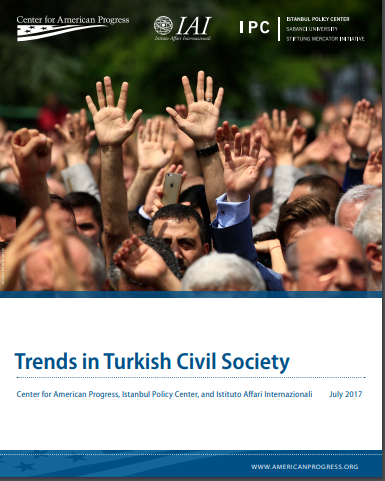
This report describes the importance of Turkish civil society and provides historical, political, economic, and legal context for its operation. It addresses the ongoing purge of some civic actors and examines the polarization that continues to divide civil society groups (CSOs) despite their shared predicament. Looking at the major challenges facing Turkey as a whole, the report offers examples of how CSOs can contribute to solutions across the board. Finally, it offers recommendations for how best to support Turkish civil society.
Publication Date
July 2017
Page Count
49