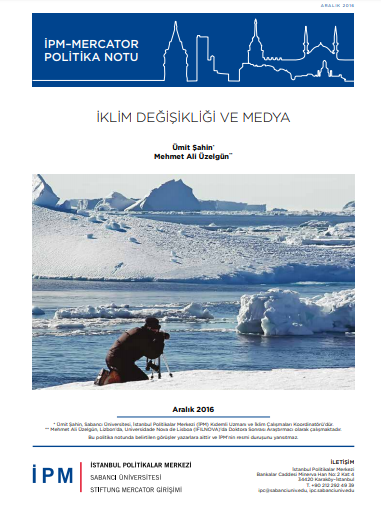
Climate Change and Media
Executive Summary
The media plays a significant role in bringing issues such as climate change, which are multidimensional, fraught with uncertainty regarding their consequences, and require swift political decisions, to the attention of the public. However, apart from periods of drought, unusual weather events, and major global developments, climate change receives relatively limited coverage in Turkey's mass media.
Based on interviews with journalists holding managerial positions in Turkey's mass media organisations, this study examines why climate change and related issues do not feature prominently on the country's media agenda and under what conditions and in which contexts they become newsworthy.
According to the findings, climate change is widely perceived as a topic that attracts little interest from readers, viewers, or the general public, generates neither circulation nor ratings, and requires a high level of intellectual engagement and specialised interest. This perception is regarded as one of the principal obstacles to increasing media coverage of the issue. Journalists also identify the intensity of Turkey's political and social agenda as a major barrier, with climate change frequently overshadowed by breaking news related to war, terrorism, and other political and social crises.
The perception of climate change as a distant, future-oriented, and abstract issue, together with the difficulty of connecting it to tangible current events and presenting it in a way that maintains audience interest, further reinforces these challenges. The study also finds that limited knowledge and awareness among journalists—particularly editors and managing editors—as well as the lack of specialised environmental reporters, significantly hinder the inclusion of climate-related stories in the media agenda.
The research indicates that climate change news is largely sourced from international news agencies and foreign media outlets, while localisation efforts and the production of original domestic reporting remain limited. It also notes that the connection between extreme weather events and climate change is often insufficiently established, and that international climate conferences are primarily covered within the framework of diplomatic relations. Furthermore, Turkey's lack of active and forward-looking climate policies is seen as limiting the ability of government institutions to create or encourage media agendas that prioritise climate reporting. At the same time, the study concludes that the influence of the fossil fuel sector as an advertiser or provider of capital does not appear to be a decisive factor restricting climate news coverage in Turkey.
Publication Date
December 2016
Page Count
21

Ümit Şahin
Ümit Şahin is Senior Scholar and the Head of Climate Change Program at Istanbul Policy Center.
umit.sahin@sabanciuniv.edu