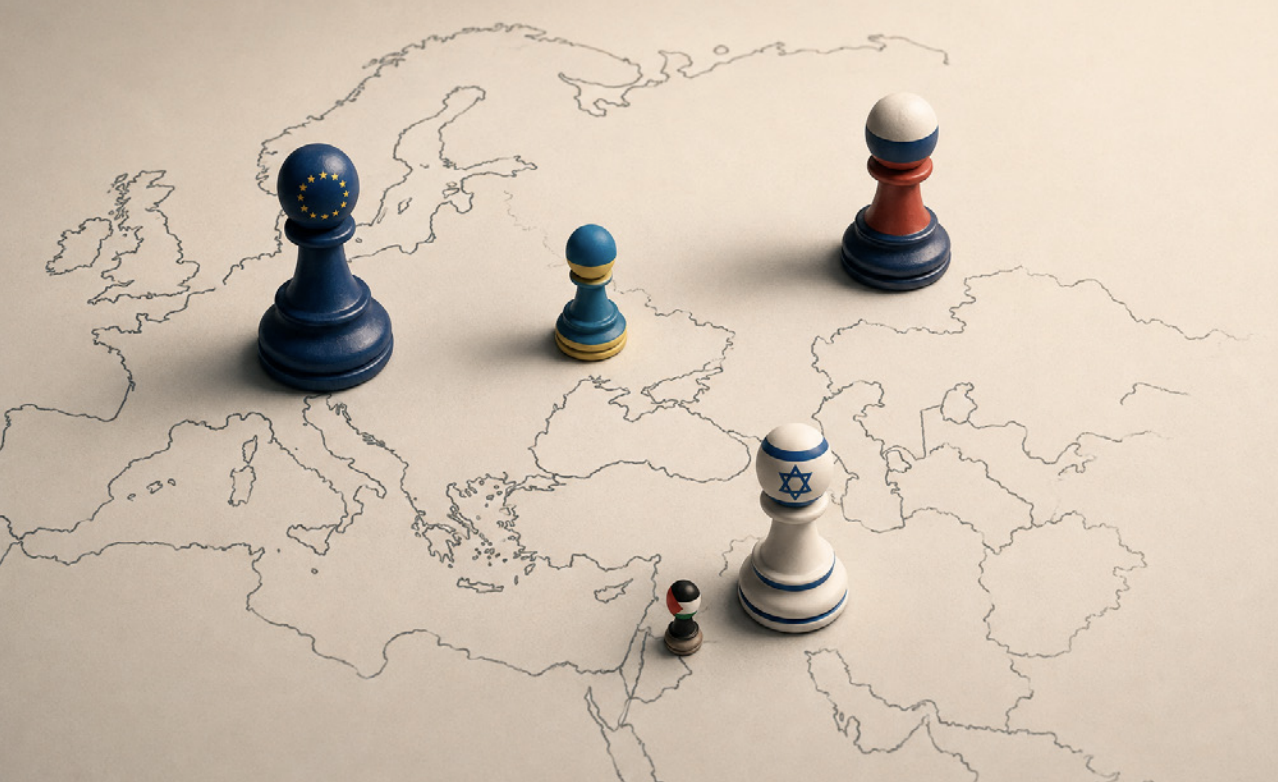
EU Norms à la Carte: A War in Ukraine, a "Situation" in Palestine
The European Union: A Normative Actor?
The European Union (EU) has long portrayed itself as a defender of human rights and a promoter of universal norms. The credibility of this positioning is not merely a theoretical concern; it also shapes the EU’s influence and effectiveness as an international actor. Yet its responses to recent crises suggest a more selective application of these principles. The EU’s strong and unified support for Ukraine following Russia’s full-scale invasion stands in stark contrast to its continued strategic engagement with Israel amid the ongoing genocide in the Gaza Strip. This divergence raises a central question: are these principles truly universal, or are they ultimately shaped by geopolitical interests?
To explore this contradiction, this analysis focuses on public communication by European Commission President Ursula von der Leyen, specifically her tweets on Russia/Ukraine and Israel/Palestine. Comparing the language used across the two cases reveals how legitimacy, responsibility, victimhood, and morality are unevenly constructed within EU discourse.
The Normative Framework
The European Union is often described as a normative actor, defined by its emphasis on human rights, multilateralism, and the promotion of universal values. Earlier debates framed Europe as a “civilian power,” relying on non-military means to exert influence,2 though this characterization was later challenged on the grounds that such influence remained dependent on broader strategic and military structures.3 Building on these discussions, Manners’ concept of Normative Power Europe gained prominence, referring to its ability to shape conceptions of what is considered “normal” in international relations.
Selective Normativity: Between Universal Values and Strategic Interests
The findings reveal that the EU’s application of norms is shaped not only by values but by power and strategic interest. The discourse surrounding Ukraine and Gaza reflects a clear hierarchy within the EU’s external relations. Ukraine was positioned as a political and moral priority while Palestine was largely reduced to a humanitarian issue to be managed. This asymmetry exposes the limits of the EU’s claim to universality. Rather than challenging existing power relations, the discourse surrounding Israel/Palestine often reproduced them by shielding Israel from the level of scrutiny and accountability directed at Russia.
Publication Date
August 2026
Number of Pages
13

Damla Çakmak
Damla Çakmak received her Bachelor’s Degree from McGill University where she studied Political Science, History and Middle East Studies. She obtained her Master’s Degree in Politics of the Middle East from SOAS, University of London.
damla.cakmak1@sabanciuniv.edu