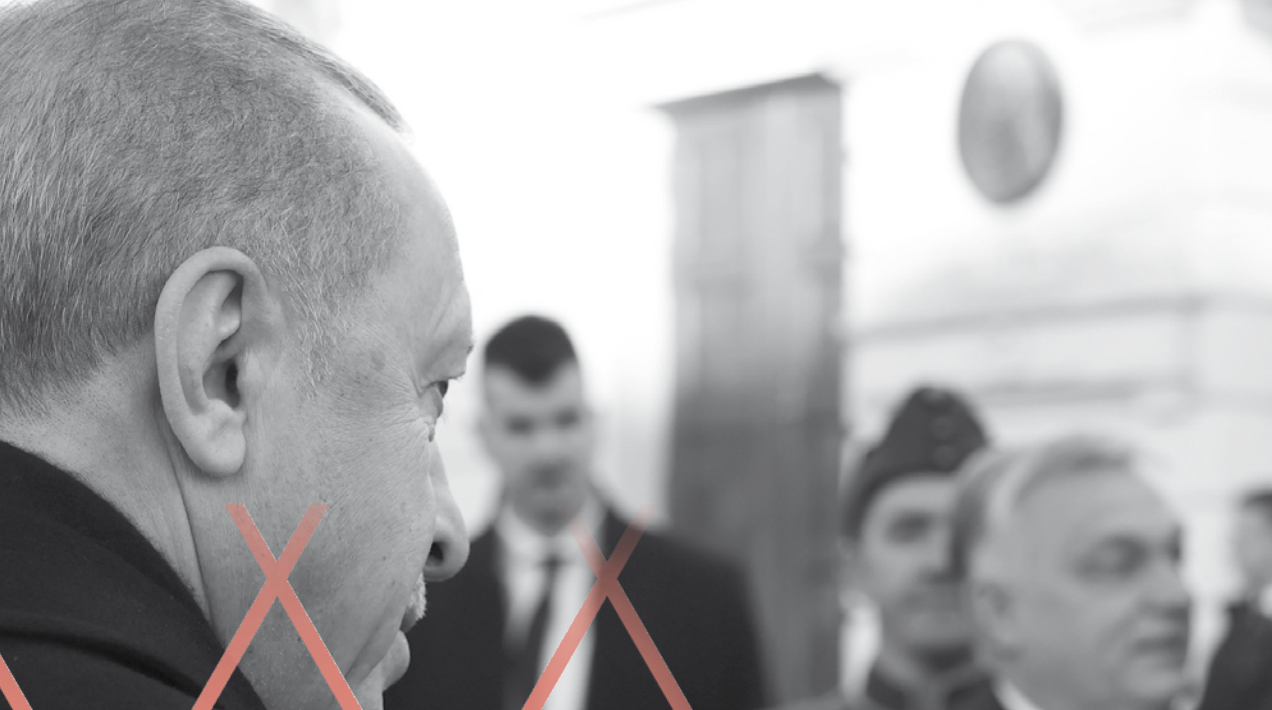
Hungary’s Opening Toward Turkey: From Economic Diversification to Political Partnership
Hungary’s Viktor Orbán and Turkey’s Recep Tayyip Erdoğan met at least 20 times between 2013 and 2024. During this period, Turkey has become one of the main pillars in the foreign policy planning of Prime Minister Orbán. This report, based on interviews and policy documents, investigates why Hungary’s foreign policy opened toward Turkey over the last decade. It argues that shared anti-Western sentiments, mutual political isolation, and domestic political interests have driven the partnership.
KEY FINDINGS
- A Shift from Economic to Political Cooperation
Hungary’s initial opening toward Turkey in 2013 was framed as an economic diversification strategy. However, after Turkey’s failed 2016 coup attempt and the 2015 migration crisis, both leaders became isolated in the West over rule of law concerns. Thus, Hungary’s economic opening evolved into a politically symbolic alignment with Turkey and other Turkic nations.
Trade between Hungary and Turkey intensified, but the results fell short of expectations. Instead, cooperation on migration, energy, NATO enlargement, and Turkey’s EU integration overshadowed economic ambitions. - The Instrumentalization of Hungary’s Eastern Identity for Domestic Political Gains
In the 2010s, the ruling FIDESZ party in Hungary revived myths and truths about Hungary’s Turkic origins to provide an ideational base for its Eastern Opening. Hungary’s inclusion as an observer in the Organization of Turkic States (OTS) since 2018 has institutionalized these ties.
While Hungary’s affiliation with the OTS carries long-term economic potential, Orbán has used it to justify Hungary’s identity as non-European, justifying his non-alignment with EU norms and foreign policy. - Hungary Sustains Dependence on Russia by Promoting Turkey’s Gas Hub Ambitions
For Turkey, Hungary is a crucial partner in promoting its ambition to become an energy hub, supplying Russian, Azeri, and Turkish gas to Europe. Turkey is highly reliant on Russia for gas imports, and Russia is also using the country for transit to EU member states, including Hungary.
While the EU supports diversification away from Russian energy, Turkey’s gas hub role risks prolonging Russia’s presence in the European market—a move Hungary sees less critically than other EU member states, as Budapest was the first non-neighboring country to purchase gas from the Turkish energy company BOTAŞ. - Anti-Western Cooperation in the EU and NATO
Within the EU, Hungary has acted as Turkey’s key advocate in the fields of visa liberalization and keeping Turkey on the bloc’s agenda as a candidate country. Within NATO, Budapest delayed Sweden’s membership together with Turkey.
These moves align with Turkey’s efforts to extract concessions from Western allies and share the blame with like-minded actors for disrupting unity. Yet, Hungary’s actions, even if they resemble some of the EU’s transactional policies, such as the 2016 migration statement, undermine the possibility of a rules-based return to accession negotiations.
POLICY RECOMMENDATIONS
Although the partnership illustrates how small states like Hungary can amplify their influence in international relations, the sustainability of this strategy depends on leadership continuity.
Despite efforts to develop cooperation in energy, trade, and investment, the partnership struggles to deliver tangible economic results due to the lack of capable Hungarian companies to fully utilize the framework created.
Therefore, this report suggests implementing the following recommendations to build a more sustainable partnership:
- To ensure the durability of the Turkey-Hungary relationship, both sides must move beyond anti-Western rhetoric and achieve concrete economic outcomes. Hungary’s observer status in the OTS is a good start in this regard because it provides an institutional framework for enhancing trade along the Middle Corridor.
- The EU, Hungary, and Turkey should join efforts to facilitate the integration of Central Asian countries.
- The EU should support energy exploration and production measures in Central Asia to incentivize energy diversification away from Russia in Hungary and Turkey.
Publication Date
March 2025
Number of Pages
41