The "New Iran" Must Still Grapple with Old Enmities
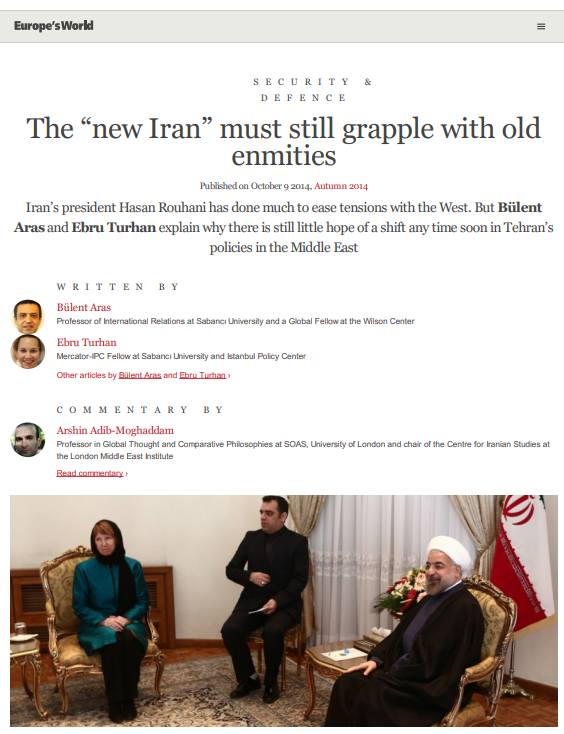
Senior Scholar and Conflict Resolution and Mediation Stream Coordinator Bülent Aras and 2013/14 Mercator-IPC Fellow Ebru Turhan's article "The "New Iran" Must Still Grapple with Old Enmities" was published in Europe's World on October 9, 2014.
The article analyzes the strategic shift in Iran’s foreign policy under President Hassan Rouhani, contrasting it with the confrontational approach of his predecessor. Rouhani’s government has adopted a pragmatic, realpolitik-driven strategy aimed at easing international isolation and revitalizing Iran’s struggling economy. The interim nuclear agreement with the P5+1 marked a significant diplomatic breakthrough, reflecting Tehran’s effort to reduce sanctions, attract foreign investment, and stabilize its economy. Economic recovery is not only vital for domestic stability but also for strengthening Rouhani’s position against hardliners within the regime.
However, while a durable nuclear deal could moderate Iran’s external posture, it is unlikely to fundamentally transform the nature of the regime or its regional policies, particularly regarding Syria. Regional actors remain wary of Iran’s growing influence, prompting calls for new balancing strategies. The article argues that Western policy should combine diplomatic engagement, economic integration, and a continued emphasis on human rights. Meanwhile, shifting regional dynamics may create an opportunity for Turkey to exercise its soft power and contribute to regional stability. Ultimately, Rouhani’s political future hinges on securing a lasting nuclear agreement, which could reshape both Iran’s domestic political balance and its international role.

Ebru Turhan
Ebru Turhan is an Associate Professor of European Studies at the Turkish-German University, Istanbul. She is a member of the executive committee (September 2026-29) of the University Association for Contemporary European Studies (UACES), and a member of the editorial boards of German Politics and Journal of Contemporary European Studies.