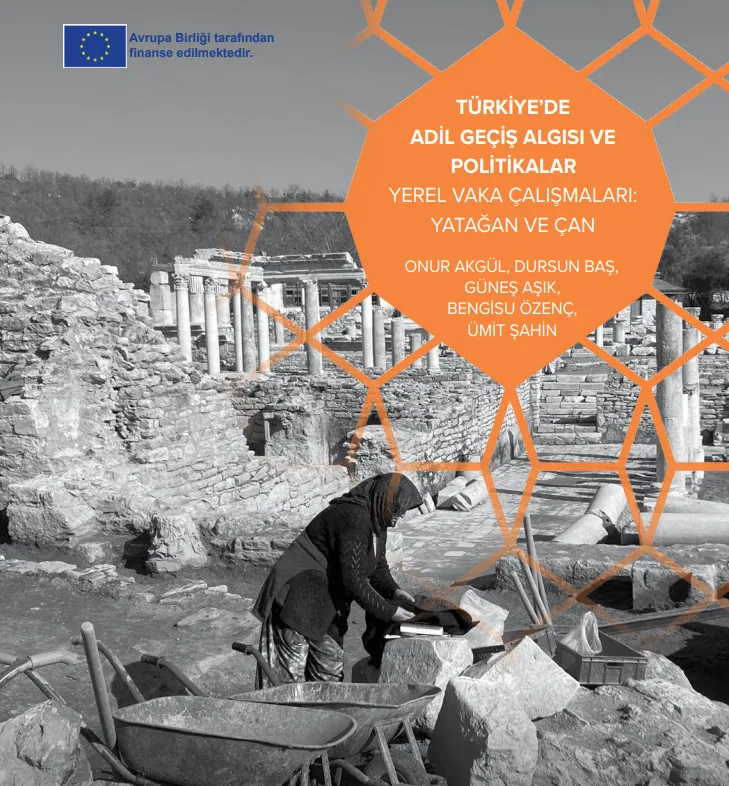
Perception of Just Transition and Policies in Turkey – Local Case Studies: Yatağan and Çan
Executive Summary
Energy transition, which forms the foundation of efforts to combat climate change, has become one of the world’s most important agenda items, particularly following the Paris Agreement. With the Paris Agreement making the obligation to reduce greenhouse gas emissions a responsibility shared by all developed and developing countries, questions surrounding how and within what timeframe the transition away from fossil fuels, particularly coal, should take place, how the challenges arising from this transformation can be overcome, and what policies need to be developed to ensure that the transition is achieved fairly and equitably have become areas of interest for all stakeholders concerned with climate change, ranging from public institutions and the private sector to experts and civil society.
The concept of a just transition, which is also incorporated into the Paris Agreement, has increasingly come to the forefront of the international climate agenda since the 2010s as an important approach to establishing both the principles and practical framework of the energy transition.
In its broadest sense, phasing out coal refers to the planned and scheduled closure of coal-fired power plants and the coal mines that supply them with raw materials, as well as the gradual replacement of coal with renewable energy sources in electricity generation. It is clear that this transition will have significant impacts not only at the national level but also in local areas where power plants and mines are concentrated. A just transition can be defined as managing the process in a way that ensures no one is left behind in affected regions, that communities are not caught unprepared, and that fair outcomes are achieved for all parties involved in the transition.
In Türkiye, the need for a just transition is particularly evident in regions where coal-fired thermal power plants (CTPPs) and coal mines are located. The district of Yatağan in Muğla, where one of the first lignite mines was opened in 1979 and the first unit of a coal-fired thermal power plant began operating in 1982, is an important area for the development of just transition policies. This is due both to the transformative impact of the coal sector on everyday life in the district and to the decades-long social debates shaped by the region's relationship with coal. Similarly, the district of Çan in Çanakkale province, one of the regions with a high concentration of coal-fired thermal power plants, is another settlement where coal plays a decisive role in almost every aspect of life, with two coal-fired thermal power plants and lignite mining areas located in the district.
The project entitled “Supporting Just Transition in Türkiye” was carried out between October 2023 and July 2024. It aimed to assess the current state of the just transition approach in Türkiye’s climate and energy policies and to identify opportunities for further developing this approach.
As part of the study, in-depth interviews were conducted with government and public officials, academics, civil society experts, representatives of professional organizations, trade unionists, experts from labour organizations, and industry representatives working on just transition issues at the national level. In addition, local-level research was conducted in Yatağan, Muğla, and Çan, Çanakkale—two regions where the phase-out of coal-fired thermal power plants may become a possibility—and consultations were held with relevant local stakeholders.
A socio-economic and employment analysis was also conducted for the two regions in which the local case studies were carried out (TR-32 and TR-22). This analysis drew on data from the Household Labour Force Surveys (HLFS) published by the Turkish Statistical Institute (TurkStat) and the Entrepreneur Information System (EIS) made available by the Ministry of Industry and Technology (MoIT).
For the purposes of these analyses, the coal economy was defined as the combined activities of the coal and lignite mining sectors and the electricity generation sector. The socio-economic analyses covered information such as the sectoral distribution of employment in both regions, the number of registered and unregistered workers, the share of coal-sector employment in total local employment, income structures, the education and skill levels of employed individuals, age and occupational distributions across sectors, and the household characteristics of people working in the coal economy.
The findings from the national and local interviews, together with the results of the local research and the socio-economic analyses of the two regions, were shared with participants and discussed through three workshops. As part of the project, a study visit to Spain was also conducted.
Drawing on the findings and perspectives obtained through the research, a series of policy recommendations were developed to facilitate the implementation of a just transition in Türkiye.
Bibliographic Data
Publication Date
December 2024
Number of Pages
153
Authors
Onur Akgül
Onur Akgül is the researcher and project coordinator of the Promoting Just Transition in Turkey project led by IPM. A graduate of Public Administration from Dokuz Eylül University, Akgül has been conducting research and analysis projects on climate change, environmental protection, air pollution, Health Impact Assessment, energy policies, democratic participation and just transition for more than 10 years, working with academia and civil society on developing policy recommendations in these areas.
onur.akgul@sabanciuniv.edu
Ümit Şahin
Ümit Şahin is Senior Scholar and the Head of Climate Change Program at Istanbul Policy Center.
umit.sahin@sabanciuniv.edu