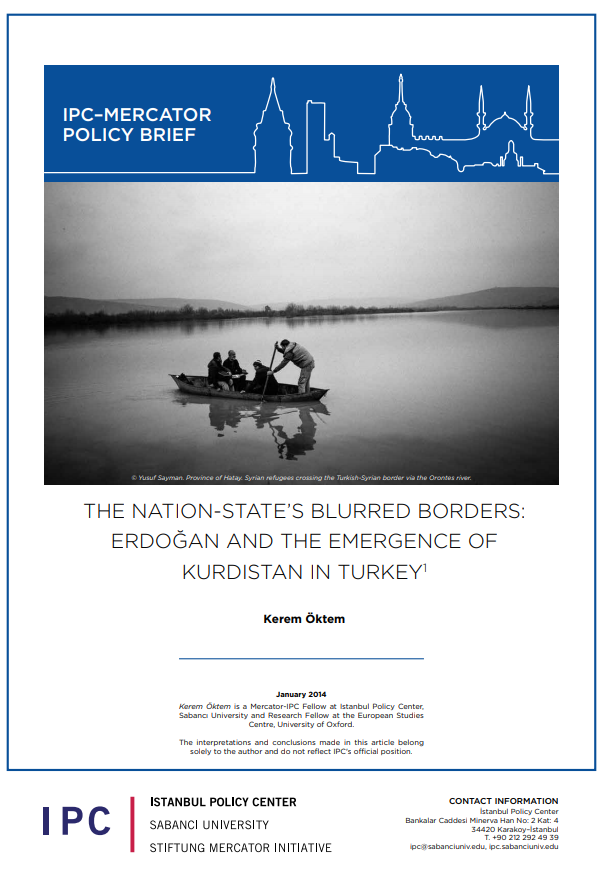
The Nation-State's Blurred Borders: Erdoğan and the Emergence of Kurdistan in Turkey
Executive Summary
2012-2013 has marked a significant departure from Turkey's traditional Kurdish policy. This departure pertains above all to the actors involved and the larger political space in which it is negotiated. In terms of actors, the Turkish Prime Minister Recep Tayyip Erdoğan has introduced into the Turkish political system the Iraqi Kurdish leader Masoud Barzani as an alternative to the incarcerated chair of the Kurdistan Workers' Party (PKK), Abdullah Öcalan. In terms of political space, leading figures of the AKP have increasingly resorted to a political language that transgresses the logic of the nation-state and instead suggests flexible, variable and softer borders between countries and people. While this proposition may resemble a shift towards liberal alternatives to the nation-state, I will suggest in this paper that both phenomena -the inclusion of external actors and the extension of Turkey's political space- are representative of a form of governance that weakens the demos, i.e. the political space of the citizens' of the Turkish Republic and limit its prospects not only for a resolution of the Turkish-Kurdish conflict but also for Turkey's democratic consolidation.
Turkey's history with its large Kurdish community has been an unhappy one. Established as a nominally secular and ethnically Turkish nation-state, the Turkish Republic has been exclusionary and discriminatory against non-Turks from its very inception in 1923. Regarding the Kurds, it followed a complex strategy of denial and forced assimilation on one side and military containment and police violence against Kurdish identity based movements on the other. Since the 1990s, when extreme oppression triggered a major Kurdish nationalist revolt in the country's Southeast, close to 50,000 combatants and mostly Kurdish civilians died (cf. Öktem 2012a, Gunter 2008, Meiselas 2008, Romano 2006). Pro-Kurdish parties, which began to run for office in the mid-1990s created a political space for opposition, yet suffered massive political repression, not least under the ruling government of the Justice and Development Party (AKP) (Cf. Watts 2010).
When Turkey's Prime Minister Recep Tayyip Erdoğan initiated a "peace process" in 2012 many observers sensed a historic turn in Turkey's attitude towards the Kurds. They felt confirmed in March 2013, when an open letter by the incarcerated leader of the Kurdistan Workers Party (PKK) Abdullah Öcalan that called for an end to armed struggle was read out in Turkish and Kurdish in Diyarbakır. Coinciding with the Newroz celebrations, an ancient festival that has become a major symbol for Kurdish nationalist mobilisation, the public delivery of Öcalan's letter marked the high point of power of Turkey's Kurdish nationalist movement. In November 2013, it was Erdoğan, who chose Diyarbakır, the symbolic capital of Turkey's Kurdish geography, to reinvigorate the peace process and to utter the term "Kurdistan", if in a qualified fashion.
The Turkish Prime Minister was not the only man on stage in Diyarbakır, though. In addition to two well-known Kurdish singers, it was The Leader of the Kurdistan Regional Government of Iraq, Masoud Barzani, who stood out. Tens of thousands in the centre of Diyarbakır cheered the two leaders with Turkish and Kurdish flags. Slogans were saturated with the words 'peace', 'brotherhood' and 'new beginning' in both languages.
Erdoğan's Diyarbakır address was not the first example of a Turkish politician trying to engage with Turkey's "Kurdish reality", as another Prime Minister, Süleyman Demirel, had chosen to name it as early as in 1991. And yet, there was something novel in this picture of Turkish-Kurdish friendship, which deserves a closer look: The fact that Turkey's Prime Minister has chosen to locate the resolution of Turkey's Kurdish challenge outside the borders of the Turkish nation state and within the framework of an unbounded territory which includes another country, i.e. Iraqi Kurdistan, and potentially Syria. This regionalisation of the country's Kurdish question by Turkey's decision makers, not as a side effect of regionalisation processes in the Middle East, but as a conscious political choice is a significant departure from the logic of the nation-state. This departure may appear as a liberal attempt to move beyond the narrow confines of the Turkish nation-state and towards a more inclusive polity. This policy, however, raises a set of new tensions, both for Turkey's Kurds and for the future of Turkey as a nation-state.
In this brief, I argue that it is may be too early to throw out the baby of the nation-state, admittedly, a big and troubled one, with the bathwater of trans- or post-nationalism. Turkey's Kurdish problem certainly has an inherent regional dimension, predicated upon the existence of major Kurdish populations divided by the territorial arrangements of the Sykes-Picot agreement and consolidated by the power balances after World War I. However, it is crucial to remember that Turkey's Kurdish sphere was created by the Turkish nation-state. It was the nation-state that sought to oppress and assimilate the Kurds and that triggered revolts and opposition to these policies and, finally, also led to the emergence of a specifically Turkey-based Kurdish political movement. This movement, represented by the Peace and Democracy Party (BDP) and the armed forces of the PKK, differ significantly from Kurdish movements in Iran and Iraq in both ideological references and forms of mobilization. Hence, I argue, Kurdish grievances can also only be solved convincingly within the framework of the Turkish nation-state, by the collective of the citizens of Turkey and its government on the basis of the legitimacy bestowed upon it by the demos of the republic.
Publication Date
January 2014
Page Count
12

Kerem Öktem
Kerem Öktem, Avusturya’daki Graz Üniversitesi’nde Güneydoğu Avrupa ve Türkiye Çalışmaları profesörüdür.
kerem.oktem@uni-graz.at