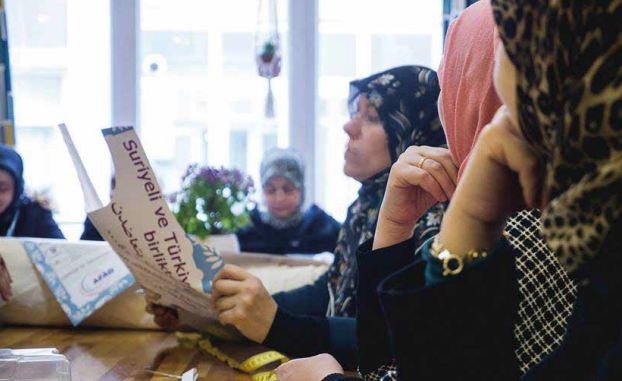
Sustainable Approaches to Humanitarian Assistance in the Field of Language Education for Adult Refugees in Turkey
Introduction
After the war broke out in Syria in 2011, many Syrians sought refuge in Turkey. Initially, Turkey adopted an open-door policy, spending public funds to provide humanitarian aid to Syrian refugees.<sup>1</sup> Following the influx of refugees into Europe, the EU committed to providing billions of euros over three years to finance humanitarian aid activities under the Financial Assistance Programme for Refugees in Turkey, signed by Turkey and the EU. According to the latest data from the General Directorate of Migration Management (GİGM), as of April 2018, more than 3.5 million Syrian refugees were in Turkey under the Temporary Protection Regulation.<sup>2</sup> Since most of these refugees appear likely to settle in Turkey in the medium or long term, language learning is a crucial issue affecting all areas, including education<sup>3</sup>, health<sup>4</sup>, and access to the labor market<sup>5</sup>. Considering the number of refugees and the ongoing international funding, Turkey is constantly developing new plans and strategies to address the challenges created by the long-standing refugee situation, such as providing language training. Language education is also one of the topics covered under education, which is the second largest part of EU funding.
Recommendations
To move from a project-based model to a more sustainable model, we propose the following. These recommendations are based on an evaluation of the experiences gained in various literacy campaigns organized since the founding of the Republic of Turkey.10 They reflect the role that civil society organizations in Turkey and other refugee-hosting countries can play. First and foremost, to make humanitarian aid sustainable, efforts should be made to establish a unit to organize and coordinate language instruction for refugees. Language education should be considered a public service and institutionalized. The need to provide language education has only recently emerged, and unlike other areas (such as health or social assistance), a structure should be built from scratch in this area. To ensure that language education becomes more widespread and to oversee the distribution of funds, national-level administration is needed in cooperation with institutions such as the Directorate of Migration Management within the Ministry of Interior and the Ministry of Family, Labor and Social Services. With this type of superstructure, the efforts of the aforementioned institutions (such as the Ministry of National Education's Public Education Centers and municipal vocational training centers like İSMEK) can be coordinated and monitored, individuals can be directed to these institutions, their development can be tracked, and it can be monitored who has access to these services and who does not. This structure can also address capacity issues and enable institutions to use additional buildings to increase their course capacity. Municipalities, benefiting from the experience gained in literacy campaigns, can construct new schools for this purpose if it is feasible from an educational perspective.
Publication Date
March 2019
Page Count
8
Maissam Nimer
Maissam Nimer is a sociologist working in the fields of sociology of migration, education, and gender with a regional focus on the Middle East and Turkey.
msnimer@gmail.com